
The Hidden Hand of Pinterest: What You Don’t Know Can Hurt Your Reach
Pinterest may look like a creative haven, but behind the curtain, it’s a tightly controlled system packed with invisible levers. While users carefully curate boards and pins, Pinterest quietly tweaks visibility, restricts reach, and limits engagement—often without a single notification. Entire accounts, individual boards, or even a single pin can be shadow-limited or suppressed, and you'll never know it's happening. This article pulls back the curtain on Pinterest’s silent moderation tactics—and why it matters more than you think.
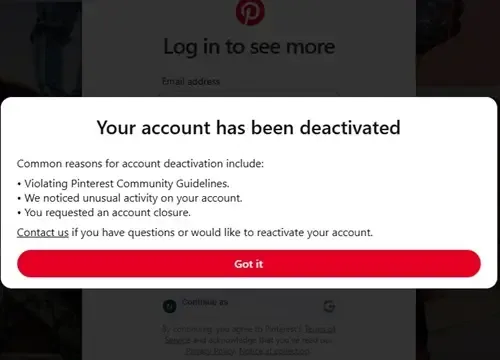
Your account has been deactivated.
The most common reason for account deactivation includes: AI fuck ups!

The First Hit: A Silent Strike That Changed Everything
The first major hit came when Pinterest suddenly removed a batch of my pins. There was no advance notice, no detailed explanation—just takedowns. Some of the content was eventually restored, but four pins remained flagged without clarity on the specific violation. On the surface, it might seem like a minor moderation action. But what happened next reveals how deep Pinterest’s hidden control mechanisms run.
As shown by the first red arrow in the graph, my account’s visibility took a nosedive almost immediately after the takedown. We’re not just talking about those flagged pins losing reach—this was a platform-wide suppression. Views dropped across the entire account: all boards, all pins, even unrelated content. Pinterest never sent a warning, never confirmed a penalty, and never gave insight into how long this suppression would last.
This is a perfect example of Pinterest’s opaque moderation system. It’s not just about content violation—it’s about control. With the flick of a switch, they can throttle your reach, mute your presence, and bury your work without ever notifying you. The damage isn’t just technical—it’s emotional. You pour time and creativity into building something, only to be penalized in silence. No appeal, no answers—just invisibility.

These are the pins that waere taken down on March 3.
- The first one isn't mine. It is a repin I saved
- The second is a board that has been deactivated. I honestly don't know why but it is not adult content as they say it is.
- Third pin is blurred from the middle and down. You can't see anythin but it is one of those where some will say it is adult and others not.
- Fourth pin is definitely not adult content.
These take downs caused a gigantic drop in views and this can ONLY be explained by Pinterest turning down my views. These pins each had less than 50 views - meaning no one ever saw them.

On May 13 (the second red arrow in the top image) they suspended my account for spam. They also blocked my domain so I could no longer direct traffic to my articles. During the past months tens of thousands of accounts were shut down due to an internal error at Pinterest.
I got my account back 24 hours later after appealing but my domain was blocked.

The Second Blow: Flagged as Spam, Silenced Without Cause
In all their algorithmic wisdom, Pinterest’s AI decided that my domain might be spamming. No evidence. No context. Just a vague, automated suspicion that instantly crippled my account’s performance even further. It wasn’t just a pin or a board this time—my entire domain was put under a shadow of doubt, dragging down every piece of content linked to it.
I attempted to appeal. What followed was not a process—it was a wall. Automated responses looped endlessly, offering no explanation, no chance for real dialogue. Each reply felt like shouting into a void. There was no human touch, no transparency, and certainly no accountability. Over and over, they repeated the same scripted lines, continuously claiming my account might be violating community standards—without ever clarifying what those violations were.
This kind of system doesn’t just fail creators—it erases them. When a platform lets AI make decisions without human oversight, and then refuses to offer a real path to appeal, it turns creativity into a minefield. Pinterest didn’t just suppress content; it silenced a voice—and did so without ever owning that decision.
Why Pinterest Does This: Profit Over People
Pinterest’s strategy is no mystery—it’s about money. By letting AI handle moderation, flagging, and even appeals, the company drastically cuts costs. AI doesn’t need a salary, health insurance, or vacation days. It works around the clock, never questions orders, and can replace entire teams of human support and moderation staff. In the short term, it’s a goldmine.
Fewer employees mean lower overhead, and those savings go straight to the top—to shareholders who want quick returns, not long-term sustainability or user trust. The incentive structure rewards short-term gains: suppress a few thousand accounts, avoid paying humans to review them, and the balance sheet looks cleaner next quarter. Everyone wins—except the creators who built the platform’s value in the first place.
This isn’t just about Pinterest. It’s a broader pattern in tech: replace accountability with automation, replace humans with algorithms, and call it “efficiency.” But when platforms treat their users like expendable data points, they slowly kill the ecosystem that gave them value to begin with.